Estimated reading time: 6 minutes
What does it mean to carry another’s history? A daughter explores what we inherit — memory, resilience, and trauma passed between generations.
—
Before my mother died she told those who were present that I had her history. This was the last message I received from my mother while she lived, even though she was not speaking to me directly but saying something about me.
I assume that my mother’s observation related to the interviews I’d conducted with her during the last decade of her life, many of which I’d taped. Later, her photographs and other memorabilia came to me, as my siblings recognized my role as historian.
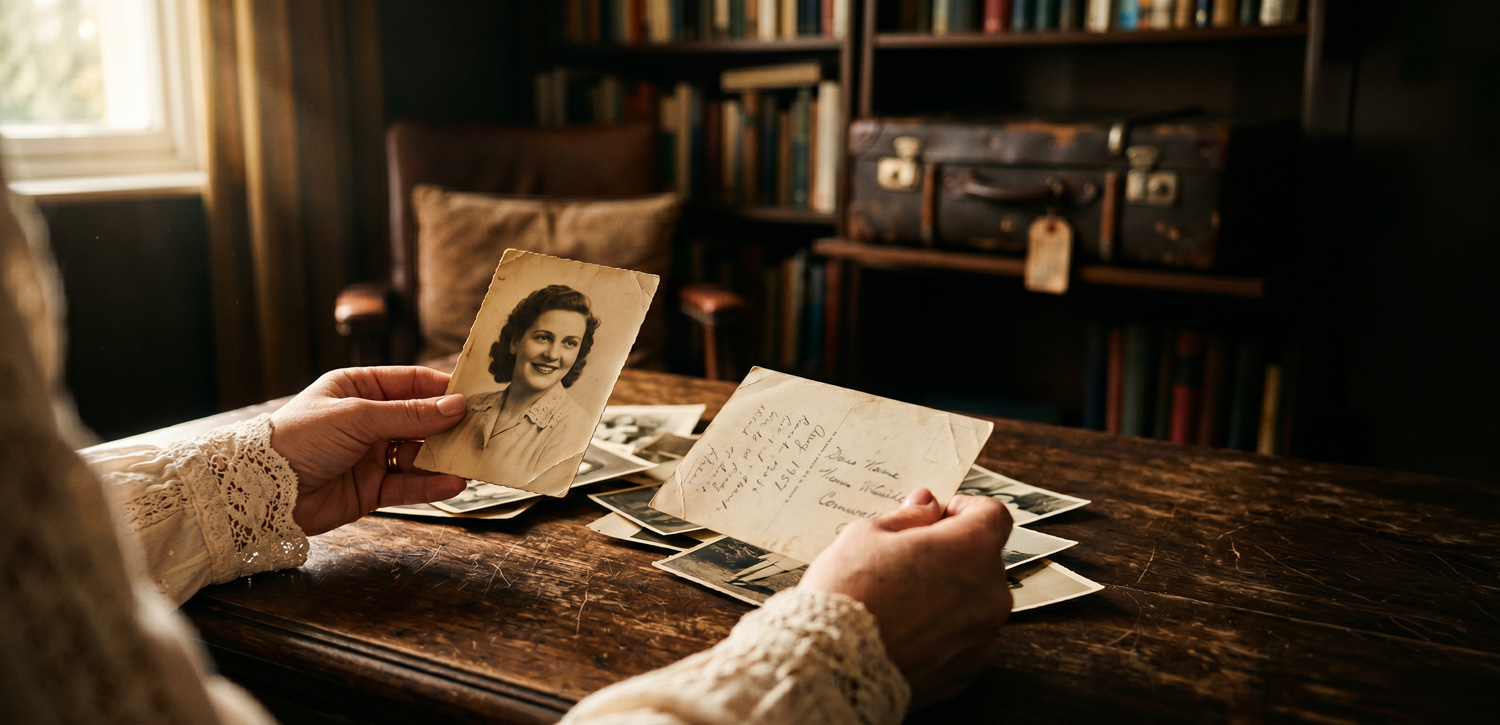
In the aftermath of her death, listening to the recordings of our conversations returned my mother to me through the music of her voice and the content of the stories she shared. Handling the photographs reminded me of one of my last visits to Texas before my mother moved to Massachusetts. We had looked through images together, and I wrote the details on the backs so that places and people from the past would not be lost. The recordings and photographs represent an obvious aspect of her history that I take forward.
I can look in the mirror and see my mother in the shape of my eyes, in my jawline, the set of my shoulders.
As I age, I notice that the skin on my upper arms loosens in the same way hers did as she grew older. My mother’s physical features are inscribed in me. Physical characteristics reappearing from one generation to the next. This, too, is a kind of carried history.
Yet, when I think of the exploration involved in writing my memoir, I consider other and more complicated interpretations of what it means to have or to carry the history of another. Sometimes I wonder if my mother, even if only sub-consciously, wished to communicate something deeper about my maternal legacy.
In his memoir, Memories, Dreams, Reflections, Carl Jung touches on the complexity to which I refer. He wrote that he believed himself to be under the influence of things or questions left incomplete and unanswered by his parents, grandparents, and more distant ancestors. It seemed to him that he had to address questions which fate had posed to his forebears, or as if he had to complete, or perhaps continue, things which previous ages had left unfinished.
Longing that is passed from one generation to the next fits the familial inheritance Jung describes. My mother was forced to flee her native Latvia during the Second World War. She lived in Austria for a time but had to do so under a false identity claiming that she was an Austrian native. Once she established her status as a displaced person, she was able to immigrate to the United States. But I do not believe she ever felt at home in this country. In some ways she remained displaced all her life.
It seems to me that my own desire for home—a place of refuge in a physical and metaphorical sense—originated in what my mother was unable to find for herself, nor nurture for me as a child. I carry something unfinished in my mother’s life.
When I first started to think about the layered meanings of my mother’s assertion that I had her history, I turned to the different meanings of to have, among them “to suffer from” and “to be subject to the experience of another.” My mother endured multiple traumas as a child and then as a young woman, injuries that accumulated into complex Post Traumatic Stress Disorder (PTSD). In one of our discussions, she acknowledged having PTSD when she first arrived in the United States, but she believed it resulted from the threats under which she’d lived during the Second World War. She assumed that she had recovered. I think otherwise. Trauma unresolved does not go away; it finds an expression elsewhere and sometimes in another generation’s experience.
Mark Wolynn in his book about inherited family trauma, It Didn’t Start With You, notes that research in cellular biology, neuroscience, epigenetics, and developmental psychology all point to the importance of exploring three generations of family history in order to understand repetitive patterns of trauma and suffering.
Though I know little about my maternal grandmother’s past, the stories that my mother shared about her mother revealed that my grandmother also experienced significant trauma in her own life, including the destruction and devastation of the First World War. She may also have been the victim of parental abuse, a pattern of behavior that she repeated with my mother.
That my mother survived the injuries she experienced is a tribute to her strength and resiliency. I believe that those qualities are part of my maternal legacy. But in claiming those attributes, I must also acknowledge other aspects of how her history affected me and our relationship. Her unresolved PTSD expressed itself in how she parented me as her firstborn and a daughter. She was never abusive but our earliest interactions were compromised, seeding a persistent emotional and physical distance between us. Because neither of us understood the origins of that behavioral pattern, we had few resources with which to address it.
We are each influenced by the histories of our parents and grandparents, perhaps those of earlier generations as well.
For example, both my mother and grandmother experienced war’s violence. I never experienced anything comparable, and yet loud sudden noises have an extreme effect on me. I startle and grow agitated, sometimes angry. It takes me several minutes to calm down. I wonder if my reaction relates to my grandmother’s or mother’s exposure to wartime bombing raids. I embody an aspect of this family history.
The past is alive in the present, whether or not we acknowledge its influence. I carry my family’s history, especially that of my mother, my primary caregiver. It resides within me. By understanding my family’s story and its effects on relationships and patterns of behavior, I have the chance to change those patterns. My narrative will add to one already underway. But it will be different.
You may also enjoy reading The Silent Inheritance: What Our Families Never Said — and How It Shaped Us, by Kalyani Adusumilli.
